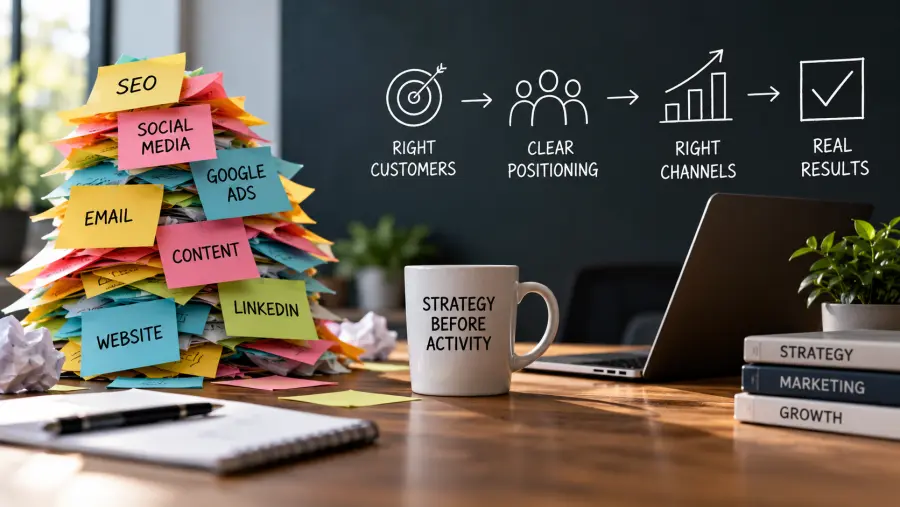
Most businesses know who their customers are. Far fewer understand why those customers choose them.
There's an important difference.
Knowing that your customers are homeowners, business owners or marketing managers gives you a starting point. Understanding what influences their decisions, what concerns them and why they might choose a competitor gives you something considerably more useful.
It gives you an advantage.
Businesses spend substantial amounts of money trying to reach new audiences through Google Ads, social media, SEO and other marketing channels. Yet some of the biggest opportunities to improve performance have very little to do with increasing advertising budgets.
They come from understanding the people you're trying to reach.
Customers Don't Always Buy What You Think You're Selling
Imagine two accountancy firms offering broadly similar services.
Both prepare accounts, handle tax returns and advise small businesses. Both have experienced teams and competitive fees.
On paper, there's very little separating them.
But one firm talks almost exclusively about its qualifications, experience and range of services.
The other focuses on the things its customers actually worry about: unexpected tax bills, confusing financial information, cash flow and whether they're making the right decisions for their business.
Which one is likely to connect more strongly with a small business owner?
The second firm hasn't necessarily changed its service. It's changed how it communicates its value.
This is where a lot of marketing falls short.
Businesses become so familiar with their own products and services that they forget customers see things differently.
A customer doesn't necessarily want an SEO campaign. They want more relevant enquiries.
They don't necessarily want a new website. They want a website that helps them win business.
They don't necessarily want CRM software. They want to stop losing opportunities because nobody followed up.
The service is what you provide. The outcome is what the customer values.
Understanding that distinction can change the way you market your business.
Your Biggest Competitor Might Be Customer Uncertainty
One of the most interesting ideas in marketing strategy is that competitive advantage doesn't always come from having a better product.
Sometimes it comes from making the buying process easier.
Think about the last time you considered purchasing an expensive product or hiring a company for an important project.
You probably had questions.
Could you trust the business? Was the price reasonable? Would it deliver what it promised? What would happen if something went wrong?
Your customers are asking similar questions.
Now consider how many business websites do very little to answer them.
They contain polished headlines, attractive photographs and a list of services, but offer almost nothing to help somebody make an informed decision.
No explanation of the process. No indication of likely costs. No examples of previous work. No answers to common concerns.
The visitor is left to do the research themselves.
And quite often, they leave.
A business that makes those answers readily available has already made the customer's decision easier.
That might mean publishing useful guides, explaining pricing factors, sharing genuine case studies or making it straightforward to speak to somebody.
These aren't particularly complicated marketing tactics.
But they can be effective because they address the reasons people hesitate before buying.
Good Marketing Starts With Better Questions
Businesses often ask what they should be doing to improve their marketing.
Should we increase our Google Ads budget?
Should we invest more in SEO?
Would LinkedIn generate more leads?
Would a new website improve conversions?
All reasonable questions, but they're difficult to answer without understanding the customer.
Before making those decisions, I'd want to know:
- What usually triggers somebody to look for your service?
- What problems are they trying to solve?
- What alternatives do they consider?
- What concerns prevent them from making an enquiry?
- What questions do they repeatedly ask your sales team?
- Why do existing customers choose you?
- Why do potential customers sometimes choose somebody else?
You don't necessarily need expensive market research to begin answering these questions.
Speak to your customers.
Look at the enquiries you've received over the past six months.
Review the questions people ask before requesting a quotation.
Speak to whoever handles sales.
Read customer reviews, including those left for competitors.
There's often valuable information sitting inside a business that never makes its way into the marketing strategy.
Your Existing Customers Are an Overlooked Source of Growth
When businesses discuss growth, the conversation usually turns towards acquiring new customers.
More website traffic. More enquiries. More advertising. More sales appointments.
Customer acquisition is important, but it's only part of the picture.
What happens after somebody becomes a customer?
Do they buy again? Do they recommend you? Are they aware of your other services? Do you maintain the relationship?
Consider a company that spends heavily attracting new customers but rarely contacts them after completing the initial work.
It may be missing opportunities that are considerably easier to develop than winning entirely new business.
An existing customer already knows the company. They've experienced the service and, assuming they're satisfied, have a reason to trust it.
That creates opportunities for repeat business, referrals and additional services.
For a B2B company, this might mean regular account reviews or sharing useful industry information.
For a local service business, it might mean maintenance reminders, follow-up communications or requesting reviews.
For a professional services company, it could involve identifying additional problems the business is equipped to solve.
The right approach depends on the customer, but the principle remains the same.
Marketing shouldn't stop when the first sale is made.
Personalisation Isn't Just Putting Someone's Name in an Email
Marketing technology has made personalisation much easier.
Businesses can segment databases, automate emails, track website activity and create campaigns for different audiences.
That's useful, but technology alone doesn't make communication relevant.
An email beginning with somebody's first name isn't particularly personal if the rest of the message has nothing to do with their needs.
Meaningful personalisation comes from understanding what matters to different customers.
Take a company providing commercial property services.
A facilities manager responsible for several buildings may be concerned about operational disruption, compliance and response times.
A business owner arranging work on a single premises might be more concerned about cost, reliability and understanding the process.
They're buying related services, but their priorities aren't identical.
Sending both the same generic marketing message misses an opportunity.
Good segmentation allows businesses to communicate more effectively without necessarily increasing the amount of content they produce.
And this is where CRM systems and marketing automation become valuable.
Not simply because they allow you to send more messages, but because they help you send more relevant ones.
Stop Measuring Attention Without Understanding Behaviour
Marketing dashboards can tell us an enormous amount about what people do.
We can see how many people visit a website, which adverts they click, where traffic originates and which pages attract the most attention.
But numbers don't always explain motivation.
Suppose a website receives 5,000 visitors in a month and generates only ten enquiries.
The immediate response might be to increase traffic.
But perhaps traffic isn't the problem.
Maybe the website attracts the wrong audience.
Maybe visitors can't find the information they need.
Maybe the enquiry form asks too many questions.
Or perhaps people simply aren't convinced that the business is the right choice.
Increasing traffic without addressing those problems could mean spending more money to achieve much the same result.
Marketing analytics becomes more useful when it's combined with an understanding of customer behaviour.
Look beyond how many people visit.
Consider what they're trying to accomplish, where they encounter difficulties and what might prevent them from taking the next step.
Sometimes improving the experience for existing visitors creates more value than attracting thousands of additional ones.
What This Means for UK Businesses
You don't need to be a large organisation with an extensive marketing department to adopt a more customer-focused approach.
For many small and medium-sized businesses, I'd start with three things.
First, review how you describe your services.
Does your website mainly talk about your company, or does it explain the problems you solve for customers?
Second, examine the buying experience.
How easy is it for someone to understand what you offer, find evidence that you're credible and make an enquiry?
Third, use what you already know.
Your sales conversations, customer feedback, enquiry data and CRM records can reveal valuable information about what people actually want.
Use those insights to improve your content, advertising, website and follow-up communications.
You may discover that you don't need an entirely new marketing strategy.
You need a better understanding of the people your existing strategy is supposed to reach.
The Businesses That Understand Their Customers Have an Advantage
Marketing channels will continue to change.
Search engines are evolving. AI is changing how people research products and services. Advertising platforms are becoming more sophisticated, and businesses have more ways than ever to reach potential customers.
But access to technology doesn't automatically create a competitive advantage.
Your competitors can use the same advertising platforms, purchase similar software and experiment with the same AI tools.
What they can't necessarily replicate is a genuinely strong understanding of your customers, built through conversations, experience and relationships.
That's something worth investing in.
Because the more you understand why customers buy, the easier it becomes to make better marketing decisions.
And sometimes, the most effective way to improve your marketing isn't to do more of it.
It's to understand your customers better.
Make Your Marketing Work Harder
At Ward Marketing, we provide digital marketing services to businesses across Essex and the UK, helping them attract the right customers and turn marketing activity into measurable business results.
From marketing strategy and lead generation to SEO, Google Ads, CRM automation and analytics, our approach starts with understanding your business, your customers and the opportunities for growth.
Get in touch with Ward Marketing to discuss how we can improve your marketing performance.