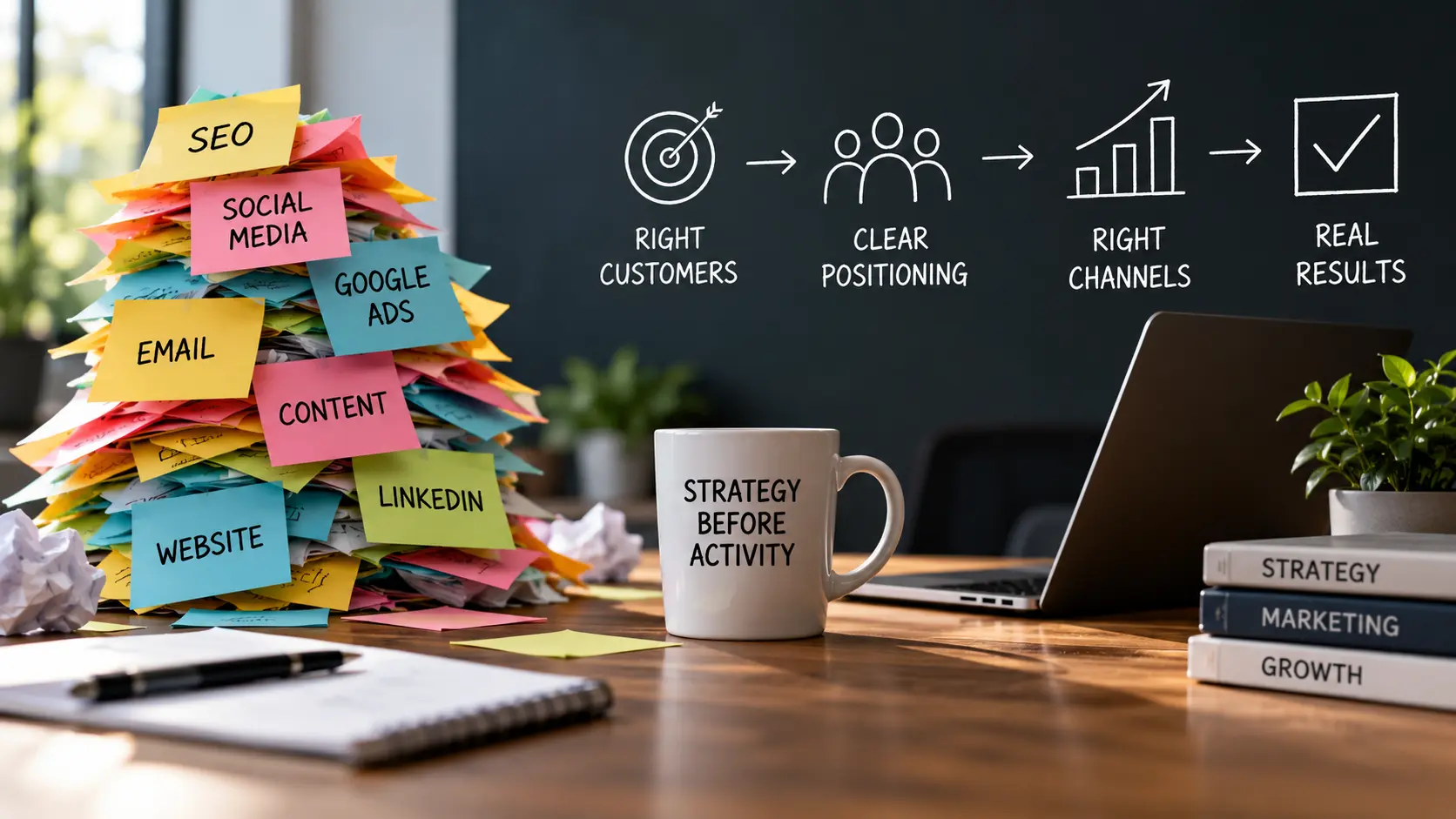
When marketing isn't working, the usual reaction is to do more of it.
Increase the Google Ads budget. Post more often on LinkedIn. Start sending emails. Improve the SEO. Try another platform.
Sometimes that's exactly what's needed. But quite often, the problem isn't a lack of marketing activity. It's that there isn't enough strategy behind the activity in the first place.
It's something we see regularly with businesses. Plenty is happening, money is being spent and different channels are being used, but it's difficult to explain how everything fits together or what the business is actually trying to achieve.
That's where marketing strategy becomes important.
Being busy isn't a strategy
One of the most useful ways of thinking about strategy comes from Michael Porter's well-known Harvard Business Review article What Is Strategy?
Porter makes an important distinction between improving the things a business does and actually having a strategy.
There's a very similar problem in marketing.
You can improve your Google Ads, publish better social content, redesign your website and send more emails. They're all worthwhile things to do, but doing them doesn't automatically mean you have a marketing strategy.
The strategy sits above those activities.
Who are we actually trying to attract? What are those customers looking for? Why should they choose us? Which parts of our offer matter most to them? And where should we spend our time and money to reach them?
Once you know the answers, choosing marketing channels becomes considerably easier.
Without them, marketing can quickly become a collection of unrelated activities.
Trying to appeal to everyone usually weakens the message
This is particularly common with small and medium-sized businesses.
Ask who the ideal customer is and the answer is often some variation of:
"Anyone who needs what we do."
Commercially, you can understand the thinking. Why turn potential business away?
From a marketing perspective, though, it's difficult to build a strong message around everyone.
Take a commercial cleaning company.
It could market itself as a cleaning company for businesses throughout the UK. There's nothing particularly wrong with that, but it's competing with thousands of companies saying roughly the same thing.
Now imagine it specialises in warehouses and industrial premises.
Suddenly there are much more specific things to talk about: large floor areas, shift patterns, health and safety, machinery, specialist cleaning requirements and minimising disruption to operations.
Its website becomes more relevant to the people it's targeting. Its advertising can be more focused. Its case studies carry more weight because they're about similar businesses.
The audience might technically be smaller, but the marketing is much stronger.
That's one of the uncomfortable parts of strategy. Sometimes you have to decide what you're not going to chase.
Start with the customer, not the marketing channel
Businesses are constantly being told about the next channel they need to be using.
You need to be on TikTok.
You need to post every day.
You need SEO.
You need Google Ads.
You need AI-generated content.
Maybe you do. Maybe you don't.
A better place to start is with a fairly simple question:
How does someone actually choose a company like ours?
For a local service business, Google searches, reviews and recommendations might dominate the buying process.
For a company trying to win large B2B contracts, the process could involve months of research, conversations, LinkedIn, industry relationships, case studies and several people involved in the decision.
Those two businesses shouldn't have the same marketing strategy.
This sounds obvious when it's written down, but it's surprisingly easy to forget when a new marketing platform or trend appears.
Don't choose a channel and then work out what to do with it. Understand the customer journey first and choose the channels that make sense afterwards.
Marketing can be part of the reason customers choose you
Another interesting piece of thinking comes from Niraj Dawar's Harvard Business Review article When Marketing Is Strategy.
One of the broader ideas is that competitive advantage doesn't necessarily have to come entirely from the product itself. It can also come from the customer's experience of finding, understanding, buying and using it.
That's particularly relevant today.
Imagine two companies offering broadly comparable services at similar prices.
One has a dated website, vague descriptions of what it does, no case studies and takes three days to respond to an enquiry.
The other clearly explains its service, shows examples of previous work, answers common questions, provides useful information and responds within an hour.
Technically, their underlying service might be very similar.
From the customer's point of view, they don't feel like similar businesses at all.
Good marketing isn't simply about getting somebody's attention. It can reduce uncertainty and make a business easier to trust.
That's valuable.
Your website, advertising and sales activity shouldn't live separate lives
This is another area where marketing often becomes unnecessarily complicated.
Google Ads is doing one thing. Someone else handles SEO. Social media is producing content. Sales has its own spreadsheet or CRM. Every few months an email goes out to the database.
Individually, each activity might be perfectly reasonable.
The problem is that customers don't experience businesses in separate marketing channels.
Someone might see one of your LinkedIn posts today, visit your website next week, search your company on Google a few days later and finally make an enquiry after reading a case study.
Which channel generated the lead?
You could argue about attribution, but it's probably the wrong question.
They worked together.
This is why we think businesses should spend more time looking at marketing as a connected system.
An advert should lead somewhere relevant. The website should continue the conversation. Good content should answer the questions potential customers are already asking. Enquiries should enter a CRM. Follow-up should happen properly. Sales should know where the opportunity came from and what that person was interested in.
None of this is particularly glamorous.
But it tends to matter more than finding another marketing channel to add to the list.
Don't confuse marketing numbers with business results
Modern marketing platforms give us an incredible amount of data.
Unfortunately, that also means it's very easy to find a number that makes a campaign look successful.
Impressions increased.
Website traffic is up.
We gained followers.
Cost per click dropped.
All useful information, but none of those things necessarily mean the business is making more money.
Suppose one campaign generates 100 leads at £20 each and another generates 40 at £35.
On the surface, the first campaign looks considerably better.
But what if two of those 100 leads become customers, while eight of the 40 leads from the second campaign convert?
The conversation changes very quickly.
Cost per lead matters, but so does lead quality. And eventually marketing needs to connect to customers, revenue and profit.
For most businesses, a handful of genuinely useful numbers will tell you far more than a dashboard containing 50 metrics.
How much does it cost us to acquire a customer?
Which channels produce our best opportunities?
What percentage of enquiries become customers?
What's an average customer worth?
Are those numbers improving?
Those are harder questions, but they're much more useful ones.
So what should a marketing strategy actually contain?
It doesn't need to be a 70-page document that nobody looks at after the first meeting.
For many businesses, a good marketing strategy can start with a few clear decisions.
Know the customers you most want to work with.
Understand why they buy.
Be clear about why they should choose you rather than the alternatives.
Work out where those people actually spend their time and how they research their options.
Choose a sensible number of marketing channels and do them properly.
Make sure those channels work together.
Then decide how you're going to judge whether it's working.
That gives you something far more useful than a long list of marketing activities.
It gives you a reason for doing them.
Strategy before activity
There will always be something new in marketing.
At the moment, much of the conversation is understandably around AI, generative search, automation and how search behaviour is changing. In another few years, there will be another collection of platforms and technologies demanding everyone's attention.
Businesses should experiment with new opportunities. Ignoring change isn't a strategy either.
But there's a difference between testing something because it could help achieve a business objective and doing it because everybody on LinkedIn suddenly seems to be talking about it.
Before asking "What marketing should we be doing?", there are three questions worth answering first:
Who are we trying to win?
Why should they choose us?
What's the most effective way of reaching them?
Get those right and the rest of your marketing becomes a lot easier to work out.
Need some direction with your marketing?
At Ward Marketing, we help UK businesses work out where their marketing efforts and budgets are best spent.
That might mean developing a clearer marketing strategy, improving lead generation, running paid advertising, strengthening SEO and content, introducing CRM automation or getting better visibility of what's actually generating customers.
The objective isn't to do more marketing for the sake of it.
It's to make the marketing you're doing work harder for the business.
Get in touch with Ward Marketing to discuss your marketing strategy.